
ABOUT MONTEREY BAY


Monterey Bay National Marine Sanctuary is one of the largest protected marine areas and offers some of the best wildlife viewing in the world! It is one of North America’s largest underwater canyons, the closest-to-shore deep ocean environment in the United States, and the 3rd largest submarine canyon in the world, twice as deep as the Grand Canyon. The head of the canyon starts just a mile from shore at Moss Landing, and is approximately 292 miles long, 7.5 miles wide, and is more than 2 miles deep at its deepest point. Because the submarine canyon is in such close proximity to shore, the Monterey Bay is one of the richest ecological regions along California’s central coast, as proven by the diverse species that call it home.
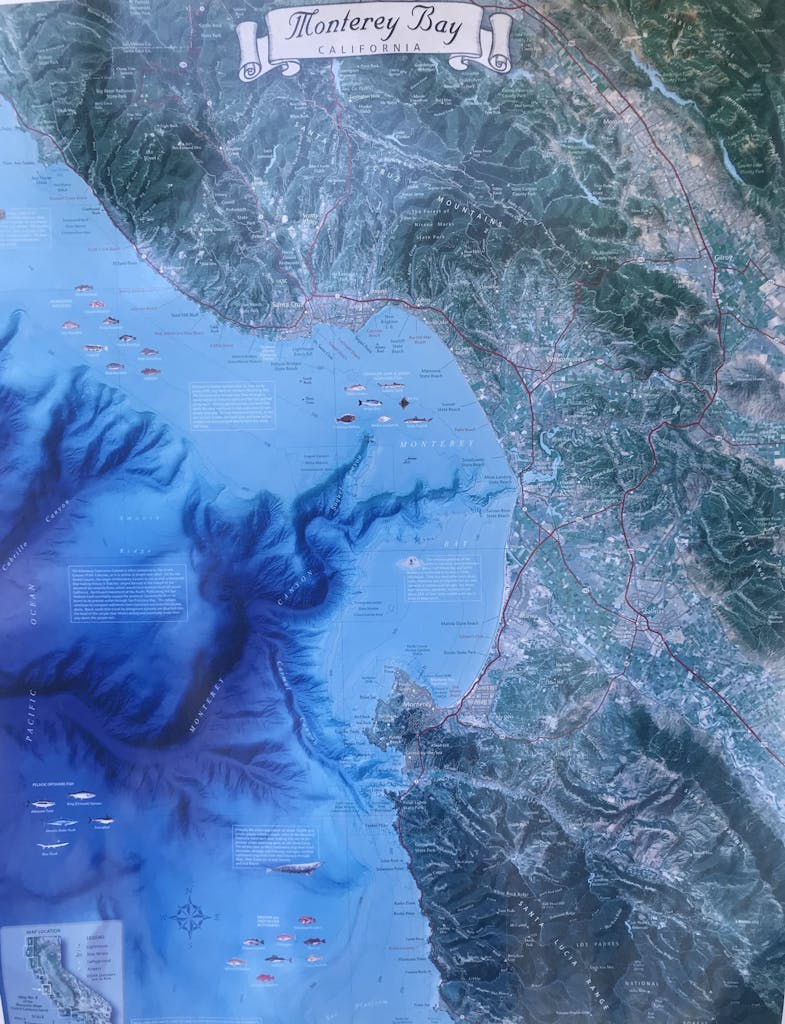
REASONS FOR SUCH DIVERSITY OF WILDLIFE IN MONTEREY BAY INCLUDE:
- Converging warm and cold water zones. The southern-most tip at Point Pinos is the boundary for many cold water mammals while the northern most tip at Point Santa Cruz is the boundary for many warm water species.
- Off shore traveling currents. Currents traveling along the canyon walls create upwellings, which send plankton and nutrient rich waters to the surface.
- The Monterey Bay also is part of the Monterey Bay National Marine Sanctuary (MBNMS). The MBNMS was designated in 1992 and was established for the purpose of resource protection, scientific research, education, and public use. The MBNMS was the 11th marine sanctuary designated in the United States and it is its largest!
- The largest expanse of kelp beds in the nation. Lush kelp forests are rich with crabs, snails, sea stars, octopus and a multitude of fishes, another crucial part of the Monterey Bay food chain.
- Sandy and muddy seafloor. Farther from shore, the seafloor is covered with sand or mud, and harbors colorful communities of fishes and invertebrates including sardines and market squid.
- Seasonal winds. Seasonal winds play an important role in the oceanography of the sanctuary. Northwest winds push the surface waters offshore during the spring and summer, replacing them with cold water from greater depths, known as coastal upwelling. These waters are rich in nutrients, fueling the growth of phytoplankton—the basis for the sanctuary’s rich marine food chain.
- 1,276 shipwrecks. Shipwrecks create artificial reefs and while they do not replace natural reefs, they create new habitats with distinct communities living in them and open water fish are attracted to them in search of food.
It is no wonder that the biological richness and unique habitats of Monterey Bay are teeming with wildlife and is one of the most productive marine ecosystems in the world. It is an underwater treasure full of the tiniest nudibranches to the world’s largest mammal the blue whale. Monterey Bay resident and transient species including 26 threatened or endangered species consist of:
- 34 species of marine mammals: pinnipeds (seals and sea lions), cetaceans (dolphins and whales) and sea otters
- 130 species of seabirds: birds that spend most of their life feeding and living on the open ocean, coming only to land for breeding
- 345 species of fish: bony fish and cartilaginous fish such as sharks, skates and rays that live in a variety of habitats including kelp forests, sandy bottoms, open water and rocky reefs
- 4 species of turtles: Out of only seven species of sea turtles worldwide, Monterey Bay is lucky to have four including the sea turtle and leatherback turtles even though they are not considered residents of the sanctuary
- Countless invertebrates and more than 450 species of algae
With such a magnificent Sanctuary, Princess Monterey Whale Watching loves showcasing our backyard for you. We are stewards of the ocean and are passionate about supporting the preservation and protection of this special marine ecosystem. Monterey Bay is so famous for activity that National Geographic, the BBC and many others come here to film. Most people will only see these magical, rare and graceful animals on TV, but we are lucky enough to view them in the wild!